Building and piloting a Digital Changing Room
Transforming the way people shop online by leveraging new AI-led tech.
Project Summary
- Took over the project after two concepts were evaluated: an experience where you pick a model that resembles you or a 3D representation of yourself and dress them with outfits you want to buy.
- Concepts were tested by using MVP versions of 'digital changing room' vendor experiences plus a diary study with shoppers in order to understand the distinct value these all bring.
- Model-led experience was validated as better for styling and outfitting, whereas the 3D-led experience was better for more accurate size calibration.
- Moderated and unmoderated sessions uncovered experience's ideal home (PDP) and proper framing (using 'find your right fit' as leading benefit). Most importantly, we learned 62.2% of engaged shoppers claimed experience would give them more confidence when making an online purchase.
- After pitching experience to digital leaders, we landed on piloting the model-led mix-and-match experience (by Veesual) in app for up to 6 weeks using the mother's day and back-to-school campaigns.
- Besides being the lead researcher, acted as PM while partnering with 30+ internal and external lululemon members and digital change room vendor.
- Pilot results beat the control experience: 54% ATC and 39% OCR higher rates. Ultimately production costs impeded experience to be productized as is. Instead, brand productized a similar experience focusing in colour, without the body representation, which is still live in the app today.
Background
lululemon was exploring how to tap on an insight called, “Digital Reflection”: when lululemon guests visit the retailer's PDP and see bodies that don't resemble theirs, it becomes hard for them to see themselves in the brand.
They sought tools to better calibrate how a garment would fit them when online shopping, which sometimes user generated content (e.g., youtube) would solve for. It was apparent current fit tools (e.g., size chart) weren't enough, and more needed to be done to help them confidently shop online and ultimately convert to the brand.
Early explorations of the solution were called a “Digital Changing Room”.
- Model-led experience: what if lululemon guests could shop for their favourite or new styles by first selecting a model that looks like them (e.g., age, height, weight, identity) to see how those clothes would look on someone similar to them.
- 3D Avatar-led experience: what if lululemon guests could build a digital twin based on their unique proportions and characteristics (e.g., body shape and curves, skin tone, etc.) to understand how an outfit would approximately fit on their body.
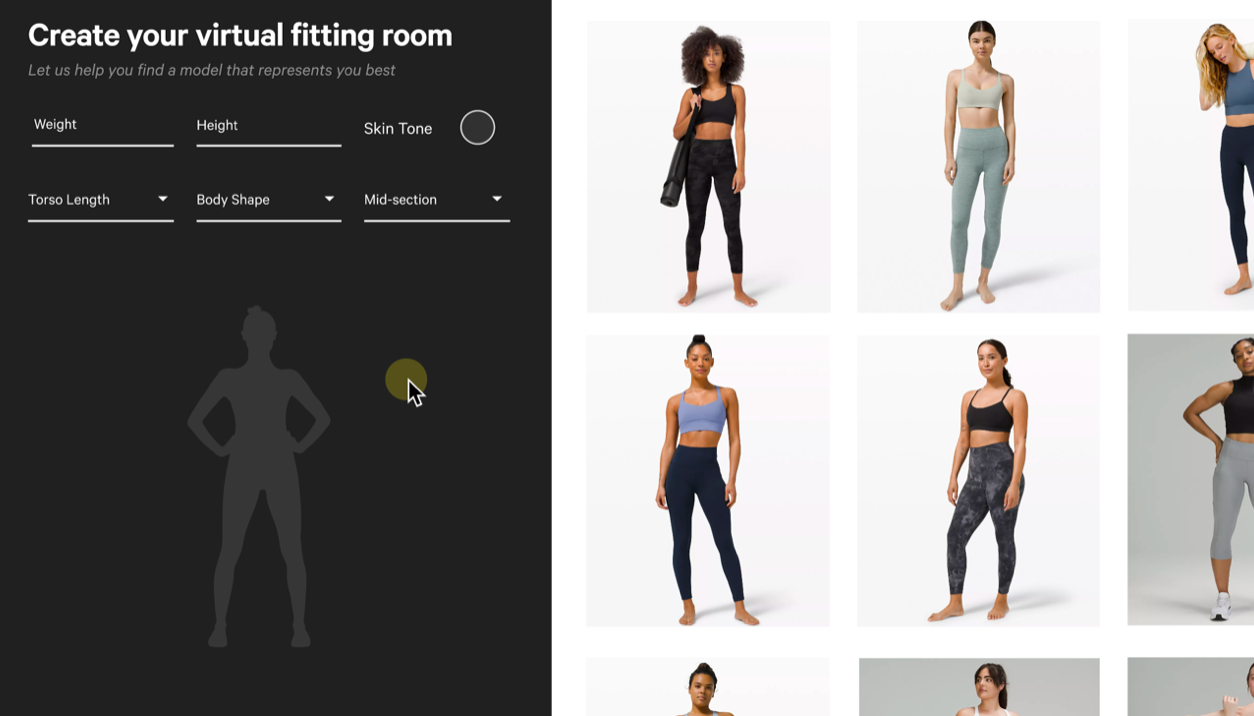
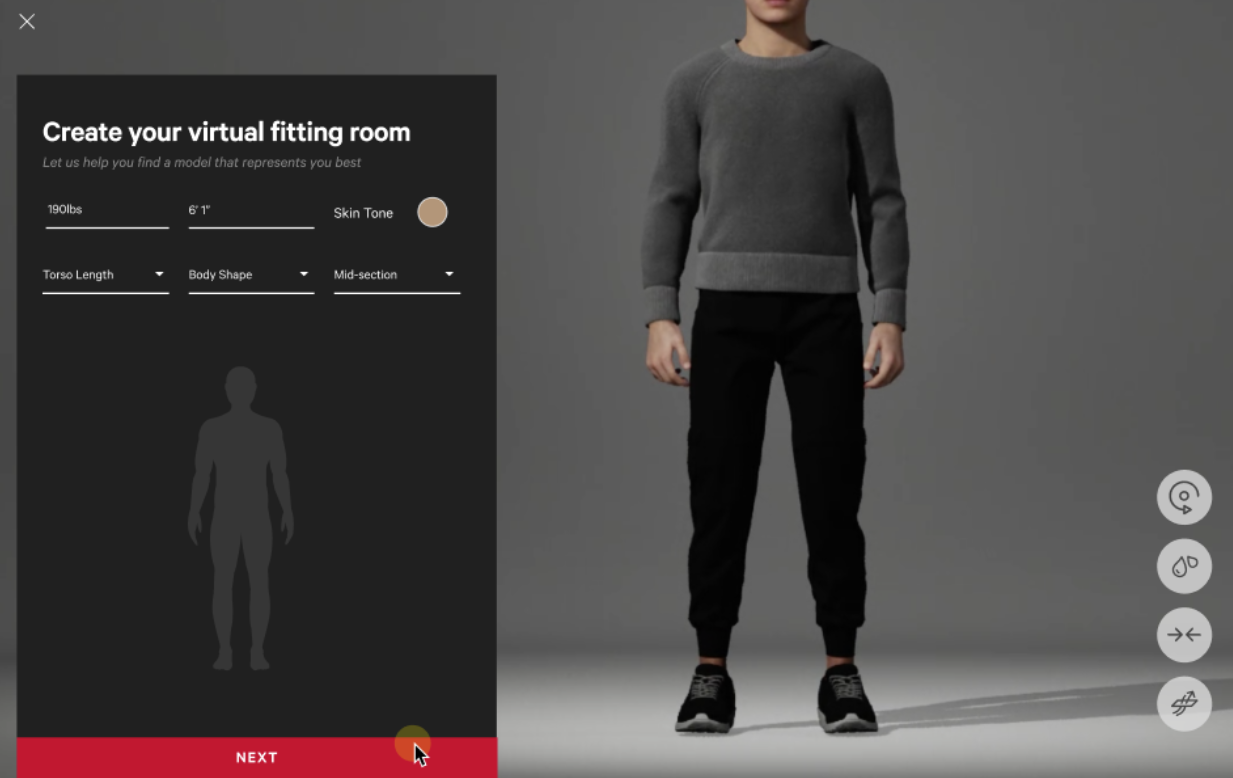
As I onboarded as a Lead on this project, my job was to carve the path forward from there on: framing and executing the next round of research, validate or invalidate those experiences use for guests, stress-test their viability and feasibility, and recommended to Senior Leadership Team whether it made sense to productize or not.
All of this was done while navigating a stakeholder-heavy organization where inputs from different teams (UX, Product, Ecomm, Brand, 3D & Product Development) and leaders (SVP, Chief Digital Officer) was necessary for projects eventual buy-in, success, and pilot launch in the brand's app.
Understanding different shopping intentions
To stress-test those two digital changing room concepts, we arrived at the conclusion that the brand wouldn't make a solution like that in-house knowing there were startups in-market with similar solutions. These aren't necessarily the capabilities the brand would invest in, but was open to rent/acquire from outside vendors.
After designing demos with these companies (Veesual, Browzwear, BODS, etc.), we aligned on a research study focused on understanding whether these solutions help lululemon guests calibrate their size and fit by getting a sample of guests to demo these experiences on their own.
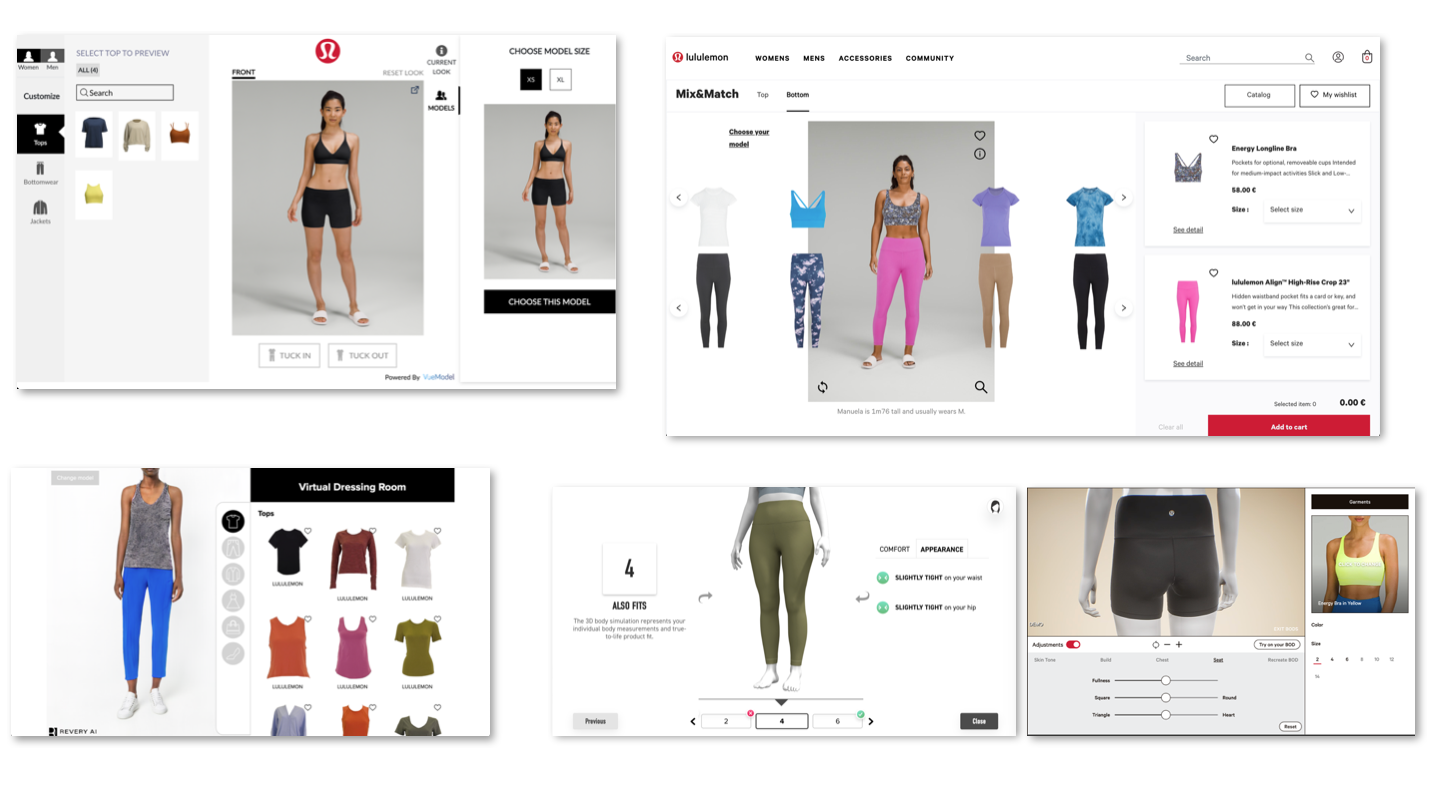
We used a combination of qualitative and quantitive methods to unpack that major research question:
In-depth interviews with 30 shoppers
- Open ended questions focused on understanding the experience of shopping online for their size and fit at lululemon.com process, rituals, pain-points, and workarounds
- Evaluative portion meant to gather reactions to different digital changing room demos – what works vs. what doesn't
- Post-demo survey capturing sentiments on experiences – ranking and likert scale questions
Size and fit diary study with 16 shoppers
- A subset of guests interviewed were invited to try one of the digital changing room demos to find their right size/fit when purchasing a pair of leggings or sports bra
- Once item was delivered to them, they were asked to complete a post-experience survey to understand whether experience recommended their right size and helped calibrate fit more accurately than without it
Besides feedback into the usability and UX elements of each specific demo prepared, research allowed us to better understand the value each kind of Digital Changing Room brings, impact to the brand and perception from consumers, and some of the behavioural frictions around it:
Shopping for Style vs. Fit
- Avatar-led solves for fit: successful at calibrating size more accurately online. Allowing to design an avatar to a specific weight, shape, and height gave shoppers more insight into how a garment would fit their unique bodies.
- Model-led solves for style: more useful as a styling tool. Using models with similar complexions or height allowed shoppers to have an idea of how an outfit would look on someone like them styled (e.g., baggy, oversized, etc.)
Raising confidence despite newness
- Impacting brand perception positively: participants felt the risk of buying online was much lower with the use of these tools, and they also felt more represented by the brand as experience leaned towards showcasing more size inclusivity.
- For some, experience was too foreign: although they found them to alleviate their online shopping painpoints, some shoppers were skeptical and cautious about experiences. Without a mental model or a clear comparisson point, they needed more encouragement to give experience a try.
Uncovering shopper's hesitations
We knew it didn't matter if both versions of the digital changing room were successful at helping shoppers calibrate size or style when online shopping as long as their hesitations weren't resolved.
To continue this research and stress-test those hesitations, we held a brainstorming session focused on frictions shoppers might be experiencing and potential UX solutions and tactics known to help (e.g. 9 out of 10 shoppers who used a digital changing room were recommended their right size.)
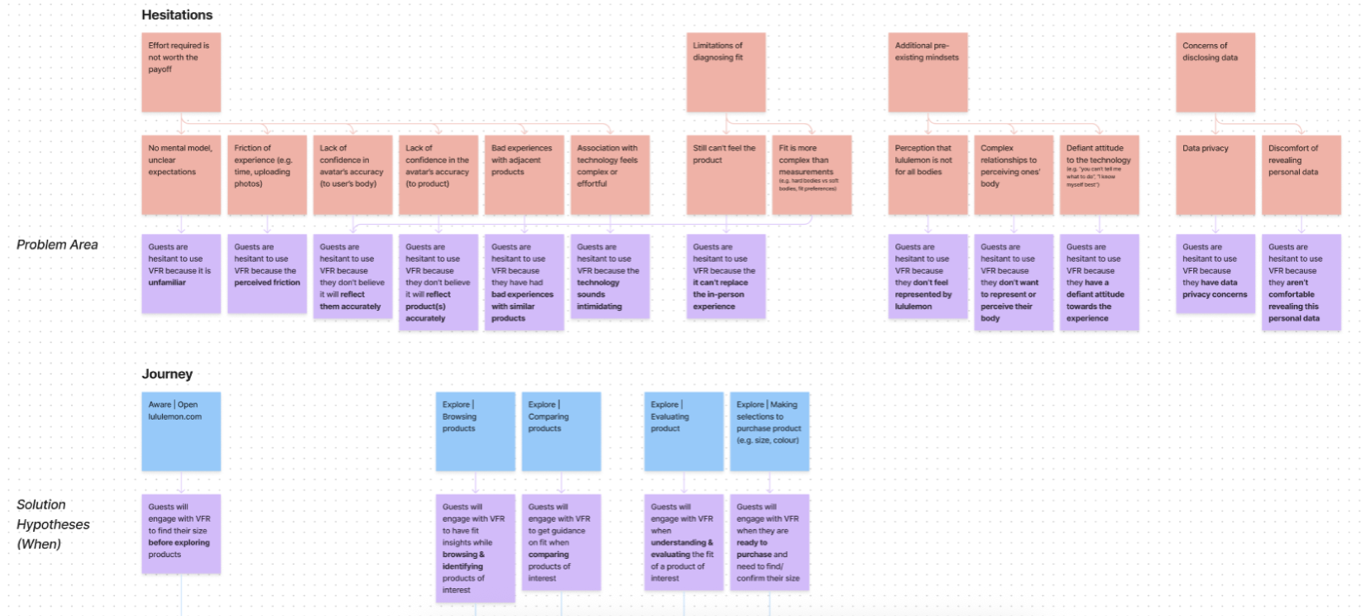
We aligned on testing these problem hypotheses and potential UX solutions through two journey-based prototypes introducing shoppers to a new digital changing room experience on lululemon.com.
- 'Meet them where they are' hypothesis: shoppers will be more likely to engage with a digital changing room if they first encounter it in context of their natural online shopping behaviors.
- 'Onboarding' hypothesis: shoppers will be more likely to engage with a digital changing room if they are well-informed about the experience before first encountering it in their online shopping experience.
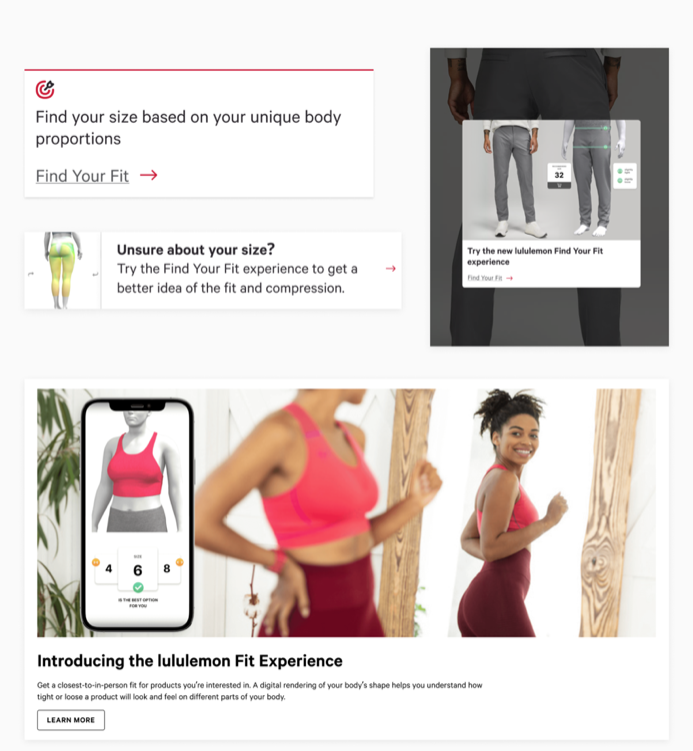
- Easing off the tech jargon: content design (CTAs, Nav Bar notifications, etc.) focused on not leading with the tech powering the product (3D-avatar, AI-based tech, etc.) and speaking about it from the benefit it provides instead.
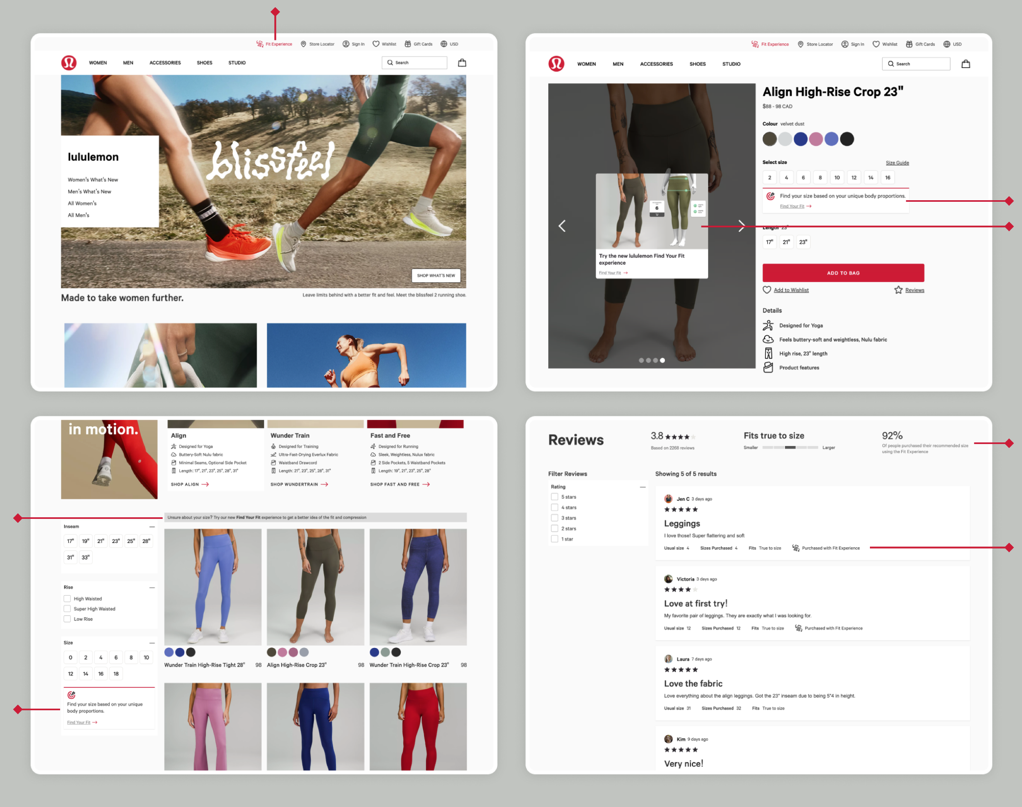
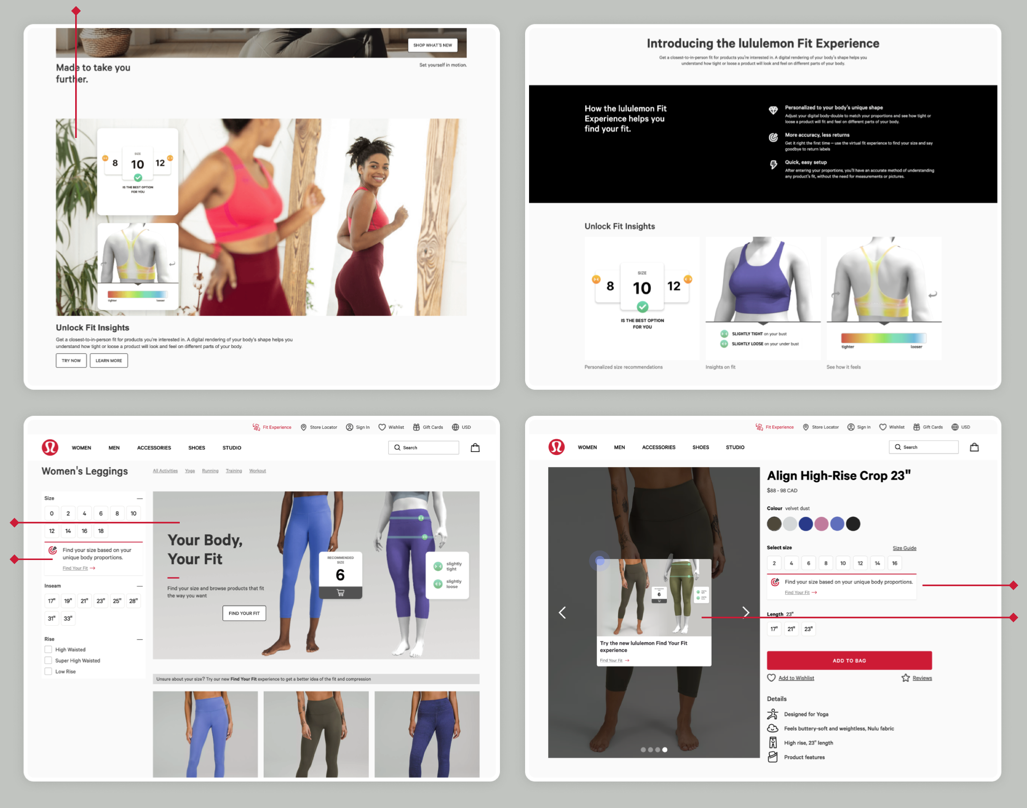
Both prototypes were tested through two rounds of research with participants (20-44 yrs old and XS to XXL sizes) who had shopped for a lululemon item in the past year from that study and claimed to have experienced size and fit problems while online shopping for it:
- Unmoderated study with 30 shoppers 16 shoppers went through 'meet them where they are' hypothesis prototype vs. 16 went through 'onboarding hypothesis prototype. At the end, both groups answered questions on how experiences would impact their shopping experience and solve for their online size and fit problems.
- Moderated study with 8 shoppers We discussed shoppers online size and fit problems with the brand, captured their thoughts on both prototypes, and answered questions on how it would impact their shopping experience if implemented in the brand’s site.
Once research concluded we learned:
- By minimizing the tech jargon behind the product, positioning the experience as a 'Fit Experience' or through its main value prop ('Find your fit') it helped solved for previously found hesitations in product.
- Shoppers would best engage with the digital changing room closer down the funnel at the PDP level, this is a moment where they're done comparing styles and are now assessing size and fit.
- When surveyed, 78.9% of engaged shoppers said they would try it to find their right fit and 62.2% claimed experience would give them more confidence when making an online purchase.
Testing conversion through app-only pilots
After discovery and validation rounds, we were confident in the product and its value for lululemon guests. Multiple SteerCo presentations to Senior Leadership later, we got the ok to move ahead with testing the experience live in the lululemon app.
The main goals of these pilots were to:
- Understand if experience helps guests make more confident product decisions through on-body product representation.
- Understand If experience can influence higher conversion rates of our female and male catalogue assortment.
- If successful, and feasible, can experience be part of lululemon's toolbox of style-based experiences.
To bring this experience to life, we partnered with French startup Veesual. They had built a digital changing room experience called "mix and match". To build it they used their proprietary LLM to read sizing information detailed in product techpacks, LLM would then size photo-studio shot images of those products and 'dress' models according to the meassurements of the clothes in the model's size.
Internally, we partnered with every team involved in the production of the campaigns selected for tests – Brand, Product, UX, Ecomm, 3D Product Development and Size & Fit, Photo Studio & Casting, Sample Ops – with my team leading the charge at making this a truly cross-functional effort.
8+ months of production after, plus some months in-between each campaign, led us to launch 2 different digital change room experiences in the app:
A more constraint test: Mother's Day POC
- Female catalogue only – ~90 hero and core styles
- Tops and bottoms
- 7 female models with distinct characteristics (e.g., skin tones, height, body shape) and sizes (XS to XXL)
- 4 weeks live
Expanding approach: Back to School POC
- Female and male catalogue – ~183 female and male hero and core styles
- Tops, bottoms, and footwear
- 13 models in total – 7 female and 6 male models with distinct characteristics and sizes
- 6 weeks live
Pilot Results & Product Impact
After sunsetting both versions, model-led changing room shoppers had outpaced non-model-led changing room shoppers – a shopper shopping through our experience or visiting it first when shopping for the same styles converted at a higher rate during the weeks our experience was live.
At high-level, the combined results were:
✓ Desirability
Guests found experience useful to calibrate styles of multiple outfit combinations, with about 370K visitors throughout pilot duration. When engaging shoppers who used the experience while live, 60% claimed it was valuable at outfit building.
✓ Viability
Add-to-cart rate and order conversion rate were 54% (OCR 6.35% vs. 4.07%) and 39% (OCR 4.69% vs. 3.74%) higher than non-model-led digital changing room counterparts, leading to ~USD$400K in indirect and direct revenue – proving it helps convert guests to our assortment at higher rates.
✗ Feasibility
For experience to be produced and be successful, it needed several inputs (like individual samples being shipped to vendor to be shot, model licensing fees, adjustments to the initial sizing of clothes on models) that could be costly and time consuming for the brand to the point of needing a full-time Product Owner/Product Manager to lead on a full-time basis.
Based from pilot results, at a modest ATC of 0.5% experience could bring in a bit over USD$ 2MM/year but the cost of producing it (which covered costs like the digitization of samples, model licenses, and SaaS fees for vendor) was sitting at ~USD$ 900K for the first year if brand were to digitize 15% of assortment.
In the end, productization wasn't recommended unless there was a 1) a way to bring down the costs of shipping and shooting samples through using ghostpacks 2) make a more strategic decision on what to digitize to reap the rewards of product (e.g., core franchises only instead of every yearly seasonal styles).
Although experience wasn't productized, its work was the foundation of current live experiences in-app like the Matching Set Builder and learnings have influenced product sizing development at the brand.
Collaborators & Credits
The project was led while at lululemon as part of their Digital Innovation team, Future Experiences.
Project couldn't have happened without the support of teams within Product & App (Natasha Kassam), UX (Najla Sekariyanti, Kat Wearing), Ecomm (Alex Williams), Campaigns (Jeane Boni), Global Brand & Sample Ops (Blair Lawton, Taryn Day), Product Development and Size & Fit (Leith Irvine), Tech & Dev (Vincent Cepeda), Analytics (Liona To) and leadership buy-in from Danny Ryder (Chief Digital Officer), Nick Engel (SVP Digital), and Sarah Rogowsky (former VP Digital Strategy & UX).
Within my team at Future Experiences, I was supported by Heather Kaiserani (Program Manager) and Ellisa Calder (Director, Digital Insights & Future Experiences) who provided their guidance while I was leading this work.
Thank you to the Veesual team (Maxime Patte, Célia Bugniot, Damien Meurisse) for being such great partners on this endeavor.
Protected
Enter the password to view this project.
Incorrect password. Please try again.